Micro-Expressions: The 7 Universal Emotions Your Face Reveals
Your face betrays you in 1/25th of a second. Learn the seven universal emotions that flash across faces before conscious control kicks in.
Imagine being able to see what someone truly feels before they've decided to show it. That's not science fiction — it's the reality of micro-expressions, fleeting facial movements that reveal genuine emotion before conscious control kicks in.
What Are Micro-Expressions?
Micro-expressions are involuntary facial expressions that occur in 1/25th to 1/5th of a second. Unlike the expressions we consciously control, these brief flashes reveal true emotional states before the brain has time to mask them.
Dr Paul Ekman, the pioneering psychologist who spent decades researching facial expressions, identified seven emotions that appear universally across all cultures. These aren't learned behaviours — they're hardwired into human neurology.
The Seven Universal Emotions
1. Happiness
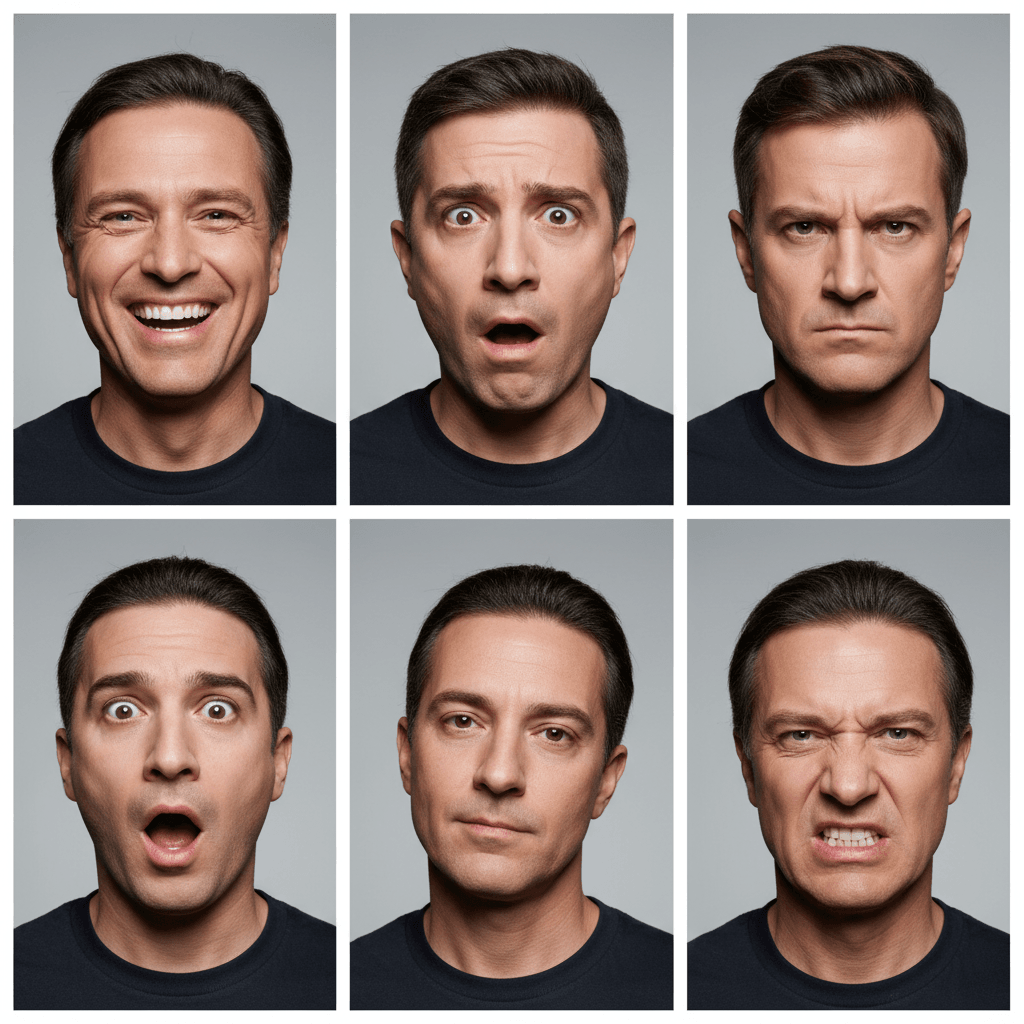
Key markers: Crow's feet wrinkles around eyes, raised cheeks, corners of mouth pulled back. Genuine happiness (called a Duchenne smile) involves the eyes. A smile without eye engagement is typically polite or forced.
2. Sadness
Key markers: Inner corners of eyebrows raised and drawn together, corners of lips pulled down, lower lip may protrude. Often suppressed in professional settings — when you spot it, someone may need support they're not asking for.
3. Anger
Key markers: Lowered and drawn-together eyebrows, tense lower eyelids, lips pressed firmly together. Spotting anger early allows for de-escalation before things escalate.
4. Disgust
Key markers: Wrinkled nose, raised upper lip, lowered eyebrows. In business contexts, disgust often signals strong disagreement or moral objection to an idea.
5. Contempt
Key markers: One side of the mouth raised (asymmetrical expression). The only asymmetrical universal expression, contempt signals superiority or disrespect. It's a relationship killer in teams.
6. Fear
Key markers: Raised and drawn-together eyebrows, raised upper eyelids, lips slightly stretched horizontally. In professional settings, fear often indicates anxiety about consequences or uncertainty.
7. Surprise
Key markers: Raised eyebrows, wide open eyes, dropped jaw. Genuine surprise is involuntary and brief. If it lasts more than a second, it's likely performed.
Why This Matters Professionally
In negotiations, when someone says "That price works" whilst flashing disgust, you know there's room to adjust. In leadership, spotting fear in team members lets you address problems before they become crises. In sales, surprise or fear during implementation discussions reveals unstated concerns.
How to Develop Your Detection Skills
- Slow-motion training: Watch interview videos at 0.25x speed. Look specifically for the seven emotions.
- Baseline mapping: Study people's neutral expressions first. You can only spot a micro-expression when you know what their face looks like at rest.
- Focus on the upper face: Eyebrows and eyes reveal more genuine emotion because they're harder to manipulate voluntarily.
- Context integration: Always consider what's being discussed when the expression flashes.
Common Mistakes to Avoid
- Over-interpretation: A single micro-expression isn't a lie detector. It signals emotion, not deception.
- Ignoring context: Fear during a horror film discussion means something different than fear during a budget presentation.
- Jumping to conclusions: Use micro-expressions as conversation prompts, not evidence.
Ready to master the art of reading faces? Our body language courses include comprehensive micro-expression training based on Ekman's research.